
Dec 212000

Ark Comments Off

movark

flag2

THE HOME PAGE OF ETHIOPIAN LIBERATION

Moto

heroam

Get the Flash Player to see this player.

1demo2

info@geghna.org


Feb 082010
Waterfall at Omo River Ethiopia

The Omo of Ethiopia is a special river, a real African Queen

The Omo River flows through the southwestern part of the country it travels through the home to some of Africa’s most unvisited and most decorated tribal peoples. A virtually roadless area, the Omo River becomes the avenue allowing access to the wonders of the area: pristine wilderness camps, unique birds and wildlife and in many ways is a journey back in time.

Ethiopia Omo River Floating in Serenity Canyon
A fisherman carries a 30-kilogram Nile Perch to the weighing bay at Usenge Bay, Lake Victoria, Kenya.  Over-fishing has drastically reduced the fish population in the lake. Photo/FILE

Future wars could be fought over lakes, rivers

Water is one of the most sought after natural resources in Africa. Many wars, especially among pastoralist communities, have been fought over it while global warming and reckless human activity have taken a heavy toll on the continent’s major lakes in the past decades.

A UNEP-produced Atlas of African Lakes shows the drastic depletion of the continent’s major water bodies by comparing and contrasting past satellite images with contemporary ones. Complicating matters further, some of the biggest natural lakes in Africa are usually spread across national borders, which means the responsibility of ensuring there is a sustainable usage of their waters is shared between nations.

But more often than not there is a sort of scramble, with the countries involved selfishly trying to outdo each other in siphoning the lacustrine resources without giving much thought to a common and sustainable operating policy. Where agreements are drawn they are rarely honoured.

Ethiopia’s Gibe 3 Dam Endangers Kenya’s Lake Turkana

Ikal Angelei
  • Satellite image of Lake Turkana. Note the jade color. The Omo river enters at the top. The river visible on the lower left is the Turkwel, which has been dammed for hydroelectric power.

Lake Turkana is a miraculous anomaly of life-giving water in a parched and unforgiving land. Formed millions of years ago in the tectonic upheavals that created East Africa’s Great Rift Valley, Turkana is the largest permanent desert lake in the world. Extinct volcanoes enclose the horizon, and the heat is so intense that when the blustery wind from Mount Kulal on the eastern shore temporarily ceases and clouds gather overhead, raindrops sometimes evaporate before they even reach the lake. It is called “ghost rain.”

In the Gibe III Affected Area

In the Gibe III Affected Area

This other-worldly scene is bolstered by the world’s largest population of Nile crocodiles which survive on another Nilotic ancestor, the giant perch, which in turn feeds on a profusion of blue-green algae. This prehistoric lake has also long been a focus for humans: its shores have revealed the oldest-known fossil remains of Homo habilis. Today, more than a quarter million residents from at least ten tribes have become masters of wresting sustenance from the harsh landscape. Without the lake, life here would be virtually impossible.

But Lake Turkana and its inhabitants now face an environmental catastrophe – and an avoidable one. The lake could start drying up when its main source, the Omo River, is depleted by a huge dam across the border in Ethiopia. The Ethiopian Government is planning a series of upstream dams on the Omo River; the most imminent is the Gibe III hydroelectric dam, already two years into construction.

There is no question that Ethiopia needs power. But the irony of the Gibe III dam is that while it threatens the economy of the Turkana region, a large share of its electricity will be sold to consumers in other parts of Kenya. For Ethiopia, the project is a commercial one: they want to make money selling the power elsewhere, not provide power to their own people. For Kenya, it’s a matter of allowing one part of the country to be devastated so that others may get a little more power.

The assault on the Omo River and Lake Turkana by the Gibe dam is projected to result in a drop of seven to ten meters in the lake’s depth in the first five years alone (the lake has already receded by about five to eight meters because of climate change). Resulting changes in the chemical balance of the water threatens the region’s tremendous biodiversity, including large populations of Nile crocodiles, hippopotamus, and over 40 different species of fish and snakes. The riparian forest, one of the last pristine dryland forests in Africa, would also be in grave danger.

The saga of Gibe III Dam is just the latest episode of human pressures contributing to the dying of Africa’s biggest lakes. Lake Chad has nearly disappeared from diversions that stopped its flow, andLake Victoria has seen major drops in its water levels from dams that let too much water out. Climate change could add several more to the list of dead or dying lakes and depleted rivers across the continent. Losing our precious water resources will make us less able to adapt to climate change.

Endangered People

Turkana’s indigenous communities are highly dependent on the lake for their food crops, livestock grazing and watering, and fishing. Any impacts to the lake’s ecosystem would disrupt the economy, leading to an increase in conflicts in the area. Considering the unstable state of peace in Northern Kenya, such damage to the local economies would invoke a threat to regional stability.

While a power purchase agreement outlining the terms of electricity sales was reportedly signed between Ethiopia and Kenya in 2006, no bilateral agreements on the use of the Omo-Turkana waterway and the dam’s downstream effects to Kenya are publicly known. The 300,000 people who live around Lake Turkana in Kenya were neither informed of the project’s impacts nor consulted on their priorities. Their situation mirrors that in Ethiopia, where the traditional economy of the Lower Omo Valley supports up to half a million people. The Ethiopian dam-affected people – who, like those on the Kenyan side, are largely indigenous peoples leading traditional lifestyles – have heard little or nothing about the project and their options, even though the changes to the Omo will upset the fragile balance of river bank cultivation and herding they maintain, unraveling the valley’s best strategy against food insecurity. Resulting scarcity could quickly lead to violent conflict in one of the most culturally diverse areas of Africa.

Even if Ethiopia’s affected communities organize to object to the plans, the government is notoriously unsympathetic to citizen concerns. In Ethiopia, civil society activists who might normally help raise awareness about such projects or advocate for affected people have been hesitant to join the fray, given their government’s restrictive policies and repressive tendencies regarding NGOs.

The financial backers of the Gibe III Dam may include the African Development Bank, the European Investment Bank, the Italian Government and JP Morgan Chase. While the World Bank has refused to consider project funding, they may still consider financial support through loan guarantees. Agence Francaise de Dévelopement, Germany’s aid agency KFW, and the Development Bank of Southern Africa may support the costly transmission line from the Gibe III Dam to Kenya’s national grid.

While such funders require an Environmental Impact Assessment, the one that has been submitted is incredibly sloppy and hopelessly incomplete. Shockingly it does not even mention that the Omo River supplies almost 80 percent of the Lake Turkana waters. It suggests that the dam will regulate the natural flooding cycle of the Omo River, eliminating the seasonal floods critical to downstream farmers. The truncated, artificial flood suggested in the EIA is ill-designed to achieve its purpose. The minimum, environmental flow is based on the single, lowest monthly flow recorded in the driest month, since 1964. There is no mention of how long it may take to fill Gibe III’s massive reservoir, during which time dam operators may only release 25m3/ sec, creating a prolonged dry season up to several years long. Ironically, while the filling of the reservoir alone could drive Lake Turkana to the brink of ecological collapse, the EIA argues that the dam will help restore Lake Turkana, not deplete it. So far, the project has continued despite the huge deficiencies in this official study, but those concerned about the impacts on Lake Turkana intend to bring their case to these agencies.

The project’s lack of transparency in other areas borders on the corrupt. The US$1.7 billion project is the single largest infrastructural work being undertaken in Ethiopia, yet its lucrative contract was handed to Italian construction giant, Salini, based on a questionable exception to Ethiopia’s own procurement rules. The uncompetitive awarding of the contract also contradicts World Bank and African Development Bank procurement guidelines, The World Bank has declared the project ineligible for project lending, unlike the African Development Bank which plans to consider the project despite the contract violation.

But this case is not just the responsibility of outside agencies and the Ethiopian dam planners. The Kenyan government must first and foremost do more to protect the interests of the peoples of northwest Kenya, and the ecosystems upon which they depend. The power purchase agreement with the Ethiopian government needs to be made public. We need to know if the impact on Lake Turkana was even considered before the power purchase agreement was signed. The ministries of Energy, Water, and Northern Kenya must account for their plans to preserve the environment and livelihoods of the region. The members of parliament representing Northern Kenya need to know what is planned, and have a chance to voice their communities’ concerns. The peoples of Lake Turkana must be heard.

————

Lake Turkana People’s Declaration

February 15, 2009

As Lake Turkana communities, Turkana, Dassanach, Rendille, Gabbra and Elmolo, we call for a reconsideration in the funding and support of the Gilgel Gibe III dam that is under construction on the upper Omo River. The Omo River is the main source of water for Lake Turkana contributing 80 percent of the lake waters.

The Importance of Lake Turkana

Turkana’s indigenous communities are highly dependent on the lake for their livestock grazing, watering, and fishing. Any impacts to the lake’s ecosystem would disrupt the indigenous economy, leading to an increase in conflicts in the area. Considering the unstable state of peace in Northern Kenya, such damage to the local economies would invoke a threat to regional stability.

We Declare

That we have given Friends of Lake Turkana (FoLT) the mandate to speak on our behalf, to communicate our grievances on the dangers that the Gilgel Gibe III being undertaken by the Ethiopian Government poses on our livelihoods and the survival of our natural resource, Lake Turkana.

We, the local communities, indigenous peoples are custodians of the biodiversity of Lake Turkana and its environs and have the inalienable right and responsibility to continue to manage, save, and further develop the biodiversity and above all enjoy protection from any destruction of the ecosystem and above all any external commercial interests that destroy the lake and its environs.

Aware of the reduction in the size of the lake brought about by Climate change

Aware of the concerns over the authenticity of the Environmental Impact Assessments carried out by the Ethiopian government.

Aware of the possible dangers that the Gilgel Gibe III poses which include but are not limited to:

• Retreat of Lake Turkana
• Increase in lake salinity
• Destruction of indigenous economies
• Loss of riparian forest and biodiversity
• Transboundary Issues
• Hampering potential development

Express our common concern of the dangers posed on Lake Turkana, its ecosystem, and our indigenous livelihoods by the Gibe III dam under construction on the Omo River which is a tranboundary river, shared by Ethiopia and Kenya

We oppose any current push towards development that is driven predominantly by commercial interest and which undermines our indigenous economies and denies us the little control we have over our already undermined survival.

Call to Action
We call on the Government of Kenya to take up the responsibility of protecting its citizens from having their indigenous livelihoods and potential development destroyed.

We call on the Government of Kenya to take a holistic approach to development, promotion of local control over resources, the active participation of the local communities in decision making, and ensure they are informed and consulted through out the process

We call on the Government of Kenya to take a lot more responsibility in the protection of its natural resources like Lake Turkana and others that are in danger of catastrophic damage due to lack of proper assessments and trade offs between indigenous community rights and development.

We call on the Government of Kenya to recognize the dangers posed by the Gibe III dam on the Lake Turkana and its ecosystem, and the animals in the lake as well as its peoples.

We call on the International Community to initiate a process to negotiate a legally binding agreement that follows the guidelines of the World Commission for Dams to ensure protection the rights of indigenous and local communities over their resources.

Our Declaration
By signing this document we declare that we stand alongside the Friends of Lake Turkana and have given them the mandate to undertake the necessary action to ensure the protection of Lake Turkana and its ecosystem, its people and their economies. We believe that the process undertaken to give the green light to the Gibe III project did not meet the required standards set by the World Commission for Dams. We were neither informed of the project’s impact nor were we consulted at any point of this process.

————

Lake Turkana

The region around Lake Turkana has become famous as one of the great sources of evidence of modern man’s earliest existence. It attracts the adventurous and the inquiring, for many have heard of its fearsome terrain. Windswept and very hot the lake lies in desert or semi-desert about 650 km, by road, north of Nairobi. Just a fraction under 300 km long and 60 km across at its widest point, this desert ocean has become known as the Jade Sea. Named Lake Rudolf by the first Europeans who set eyes on it—Count Teleki and Lieut. von Hohnel—who reached its shores in 1888, it was renamed Lake Turkana in 1975.
Oryx
The eastern shore is reached from Maralal along a road requiring time, patience, and skill to negotiate. In places not much more than a track and in places a lava field, this road is strictly for the adventurous and for four wheel drive vehicles. Two hundred twenty-five km after leaving Maralal you reach Loiyangalani , the only settlement of any size along the eastern shore. A welcome sight is Oasis Lodge, a simple place, but seemingly the height of luxury in its austere surroundings. The first sight of the vast expanse of the Jade Sea is certainly awesome. A lake in a desert is itself amazing but this one with its dramatic scenery even more so. Less than 30 km east of Loiyangalani Mount Kulaltowers almost precipitously to 2164 m from the lake level of 370 m. Kulal is one of three International Biosphere Reserves in Kenya. The location is always windy but from time to time sudden gales whip down from Kulal to the lake turning its placid waters into a tempest in minutes.

=========

=======

=========

Lake Turkana dying

“It is unclear how much the Gibe III will affect Lake Turkana,” says Paul Ikmat, a hydrologist. Nobody has really done the studies. But as a hydrologist I find it hard to see how it couldn’t have a significant effect. If the level falls any further, there is real danger that the water will become too alkaline to drink and damage the delicate fisheries.”

Over the years the lake has been gradually shrinking and becoming increasingly salty and highly alkaline, its water barely drinkable. Funded partly by European Investment Bank and African Development Bank (AfDB), the Gibe III hydro-plant is expected to generate 1,870 megawatts of electricity in 2013, a fact that is bound to benefit Kenya and other electricity-hungry neighbouring countries.

Ethiopia says that besides power generation the dam will also reduce River Omo’s devastating floods that killed at least 360 people and thousands of livestock in 2006. Activists have accused the government of Kenya of remaining indifferent to the issue since it stands to benefit from the surplus power to be generated from the dam.

Kenya is bound to benefit from the more than 500 megawatts earmarked for export from Gibe III to neighbouring countries. This will help meet her electricity demand that is expected to rise to 2,000 megawatts in the next five years, double the present installed capacity.

Against a backdrop of intensive protests from various lobby groups, a delegation of Kenya government officials led by the Director of Water Services, John Nyoro, gave the project a clean bill of health after a two-week fact-finding mission in Ethiopia in June 2009. The receding of the lake was due to unrelated upstream development, they said.

“This dam does not consume water. The water passing through it will only be used for the purpose of turning the turbines after which it will be released downstream,” said Nyoro. To gain more say in the management of River Omo, Kenya has been pushing for a Co-operative Framework Agreement (CFA) with Ethiopia.

The CFA is supposed to provide the legal framework for the establishment of a Basin Commission that will act as a clearing authority for any developments in Lake Turkana basin, besides compelling Ethiopia to consult Kenya in case of any future changes in water use of Gibe III Dam. However, Ethiopia has adamantly turned down this proposal saying its own monitoring system is sound.

Lake Victoria is perhaps, owing to the fact that it’s the source of the Nile, Africa’s most politically significant water mass. With a surface area of about 69,000 kilometres square and sustaining the livelihoods of an estimated 25 million people in its immediate surroundings, the massive lake is not only the largest fresh water body in Africa but also supports the largest inland fishery on the continent.

But environmental challenges have beset the lake in recent years, prompting concerted efforts by various organisations aimed at conservation and encouraging sustainable utilisation of this vital reservoir.

The Lake Victoria Environmental Management Project (LVEMP) is the main conservation body established by Kenya, Uganda, and Tanzania in partnership with Global Environmental Facility (GEF) to rehabilitate the lake’s ecosystem in a manner that would be beneficial for the riparian communities and the national economies.

The major challenges facing the lake have been water hyacinth, over-fishing, pollution through industrial and urban effluence and the receding shoreline. Sustainability of fisheries is also threatened by over-fishing, pollution and the ecological instability resulting from the introduction of the Nile Perch.

Brought in 50 years ago and currently accounting for 60 per cent of the lake’s commercial fish catch, the Nile Perch preys on other fish, which has reduced the lake to what researchers have termed a “three-species fishery” consisting of dagaa, tilapia and the perch. The Lake Victoria Fisheries Organisation (LVFO) was established by the three countries sharing the lake and is supported by the European Union to coordinate and manage fisheries resources in the lake.

According to environmentalists, the lake’s shallowness, limited river inflow and large surface area relative to its volume make it vulnerable to the effects of climatic change. By 2006, the water levels in Lake Victoria reached an 80-year low, for which hydrologists squarely blamed Uganda for releasing more water to the Nalubaale and Kiira hydropower dams than allowed by the ‘Agreed Curve’ treaty between that country and Egypt.

But regional and international pressure forced Uganda to reduce the inflow at the two dams in March 2006. Being the source of the Nile, a river that supports millions of livelihoods downstream, Lake Victoria has been a source of controversy between Egypt, Sudan and East African countries for a long time regarding treaties that were signed during the colonial period.

The Nile Water Agreement of 1929 was signed by Britain on behalf of its East African colonies. It not only forbids countries surrounding the lake from having full use of its waters, but also grants Egypt the right to police the entire length of the Nile, including Lake Victoria, to ensure that water is not diverted to the riparian countries in a manner that will affect the river’s volume downstream.

The second treaty in 1956 granted Egypt and Sudan a combined share of 74 billion cubic metres of the Nile waters, technically giving the two nations a near monopoly of the 6,700 kilometre-long river. An article published in the UK’s Guardian newspaper in 2004 claimed that the international community and donors are reluctant to question the validity of the colonial treaties for fear of upsetting Egypt, a key ally of the United States.

However, meeting in Kinshasa early last year the five East African Community member states renewed their quest for equal access to the Nile basin waters by endorsing the River Nile Cooperative Framework Agreement, subsequently trashing the discriminative colonial treaties.

Other efforts by upstream nations to reclaim their rights to the expansive water system have been through Nile Basin Initiative, a group comprising water ministries from the 10 Nile River riparian countries. Formed in 1999, the Initiative is yet to formalise a comprehensive agreement for allocating the Nile resources. But at the moment all these efforts remain more on paper than practise, with Egypt threatening to declare war on any nation that flouts the two colonial treaties.

============

=============

=========

Ethiopian dam spells death for Lake Turkana

By Lepalo Gideon

In the wake of the ongoing rains, the vast expanse around Lake Turkana is a beautiful landscape, sprouting with colour from wild flowers in fulbloom and tall, green elephant grass.

After a long, three-day journey by hardy vehicles, under endless open skies across some of Kenya’s most expansive rangelands, the journey finally winds into the turquoise lake that looks like a glittering extension of the land.

In 1964, British travel writer John Hillaby, who travelled by camel caravan for 1,000 km to the lake, was so enthralled by the sight, which he described as ‘an oasis in the middle of nowhere’, in his book, Journey To The Jade Sea.

However, this beauty that has for many years drawn tourists and travellers to behold its enthralling presence has been in the news of late, as an environmental gem threatened with extinction. A huge hydro-electric power dam, under construction on the Ethiopian side of the border, will divert the river Omo, the main vein that empties into Lake Turkana.

Environmental experts have warned repeatedly that the project will kill the lake. The section of the river, from the dam to Lake Turkana, will dry up completely as the eleven billion cubic metre reservoir is filled up.

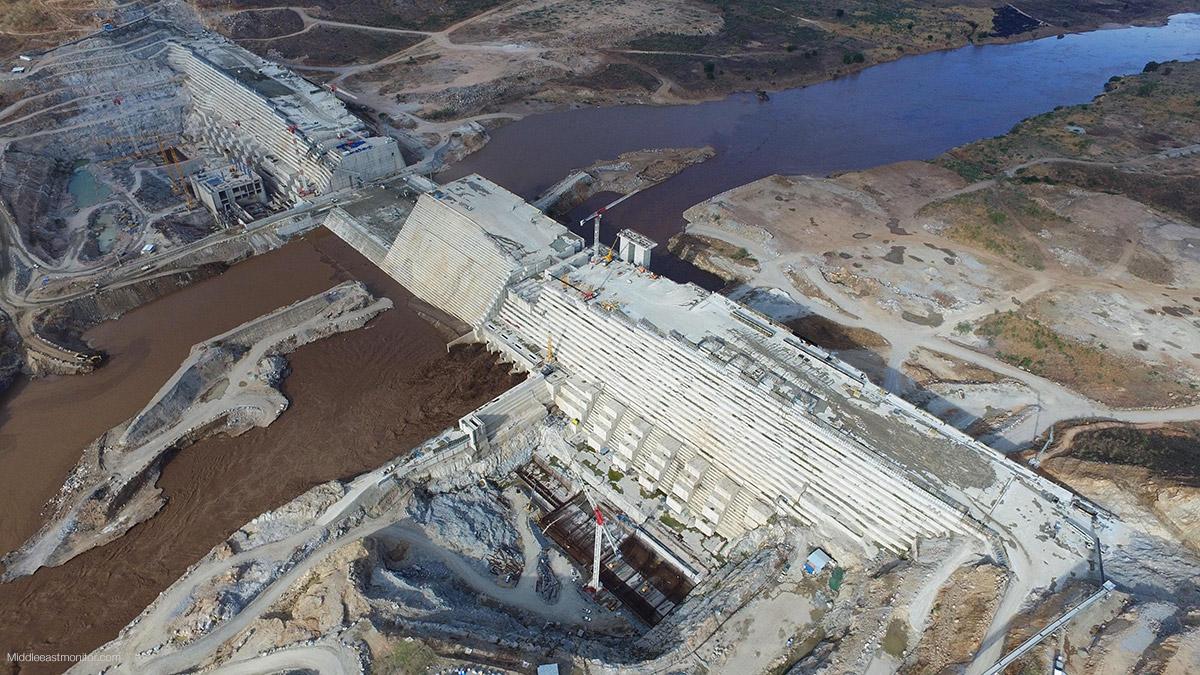
The Gibe III Dam is already at an advanced stage of construction, a private partnership planned as part of a 25 year national energy master plan in Ethiopia. Its walls will be 240 metres high, with a reservoir stretching 151 km, making it the second largest dam in Africa after the Aswan High Dam in Egypt.

Boys carry home a fish left behind in a fishing boat. [PHOTOS: PETER OCHIENG/STANDARD]

Massive construction will lead to massive environmental and social catastrophes both on the Ethiopian and Kenyan sides, environmental experts have warned.

Local and international impact reports have indicated the Turkana could start drying up once the huge dam, owned by Ethiopian Electric Power Corporation (EEPCO), cuts off the river.

Negative effects

An accurate Environmental Impact Assessment (EIA) done on the lower Omo Basin indicates the completion of Gibe III Dam would produce a broad range of negative effects which will be catastrophic within the sub region of Sudan, Ethiopia and Kenya.

”The massive reduction of inflow to Lake Turkana will be the immediate impact, given that the Omo River provides over 80 per cent of the total water flow into the lake,” stated the EIA report.

The other rivers, Turkwel and Kerio, are seasonal and can barely sustain the lake’s water level.

The report indicates that inevitably the shorelines of the saline lake will recede, leaving vast tracts bare as it ebbs to its death.

Already, due to long dry spells, the vicinity of the lake has been turning into another Sahara Desert that has already eaten into the neighboring forested Mt Kulal or Gatab

”Total destruction of the environment and elimination of forest, woodland and total mutilation of biodiversity and all riverine economic activities — including human activities and settlement will likely follow,” stated the report.

The lake is the source of livelihood for more than 3,000,000 indigenous pastoralist people.

Inference with its ecosystem will make it too saline for any marine life to survive. All communities living around the lake depend on fishing.

In a region is famous for all the wrong reasons, littered with small fire-arms and prone to ethnic clashes, the decimation of a common source of livelihood for a large population is equated by several other reports as a humanitarian catastrophe in the making.

”Cutting off the main source of livelihood can only heighten the intense conflicts emanating from inadequate supply of resources for their mutual survival,” says the EIA report.

Irked by government indifference to the looming danger, residents, led by an NGO, Friends of Lake Turkana (FLT), recently demonstrated at Kalokol in Turkana North to drive their point home.

Ms Ikal Angelei, FLT chairperson, explained the realities of the endangered lake, saying it would never be the same again once the dam closes off its main water source.

Go to war

”Nobody can touch the Nile from Alexandria (Egypt) down to its source at Jinja (Uganda). Egypt can even go to war if the river is interrupted. Why is our Government allowing this violation to our right,” Angelei said.

Turkana politicians led by Mr Christopher Nakuleu, an East African Legislative Assembly MP, said in a joint statement that the Turkana, Rendile, Dassanch, Elmolo and Gabbra, who depend on the lake for food and water, would be affected.

”It is recognised that any interference with the Lake Turkana ecosystem could be catastrophic, but no effort has been made to avert disaster,” says Pius Ewoton, the Executive Director of Arid Lands Integrated Programme.

———–

Omo Water war aginst Dams

Nyangatom cattle herder

By Peter Greste
BBC News, Ethiopia

I don’t think the government likes the Omo tribes. They are going to destroy us

Most people in Ethiopia’s lower Omo River Valley continue to exist much as they have done for hundreds of years with virtually no concession to the 21st Century, with one disturbing exception: automatic weapons.

Almost every male carries a Kalashnikov or an M-16 assault rifle, and what might in the past have been a fairly innocuous dispute over grazing or water-rights between different groups, now frequently escalates into bloody warfare.

Some fear the potential for dispute could be about to increase, because a huge dam – the second biggest in sub-Saharan Africa – is being built upstream.

The government denies that the river’s flow will be affected and indeed says the Gilgel Gibe III Dam will reduce flooding.

”It increases the amount of water in the river system. It completely regulates flooding in the Omo, which has been a major problem,” said Prime Minister Meles Zenawi.

But local people – and some academics – simply don’t believe it.

‘Rumours’

The Mursi people are one of about two dozen groups who depend, either directly or indirectly, on the river and its annual cycle of flood and recession for their survival.

Mr Leakey’s criticisms echo those of a collection of European, American and East African academics who have banded together as the “African Resources Working Group”.

The group has released a highly detailed commentary on the electricity company’s environmental impact assessment (EIA) that criticises almost every element of both the dam and the study.

In a section dealing with the impact on indigenous communities, the commentary asserts:

”Additional dispossession and disruption of the ethnic groups of the lowermost Omo basin, from the planned irrigation agricultural schemes and industrial projects described in the downstream EIA and planned by the Ethiopian government… will precipitate waves of new conflicts among groups already competing with one another over the shrinking natural resource base available to all of them.”

Adaptation

The Nyangatom is amongst the most heavily armed of the communities in the Omo Valley.

Half of the group lives over the border inside South Sudan, where most young men fought with the rebel Sudan People’s Liberation Movement during its long civil war with Khartoum. They brought back training, experience and weapons, raising the stakes even further.

Mr Leakey’s criticisms echo those of a collection of European, American and East African academics who have banded together as the “African Resources Working Group”.

The group has released a highly detailed commentary on the electricity company’s environmental impact assessment (EIA) that criticises almost every element of both the dam and the study.

In a section dealing with the impact on indigenous communities, the commentary asserts:Mursi woman

”Additional dispossession and disruption of the ethnic groups of the lowermost Omo basin, from the planned irrigation agricultural schemes and industrial projects described in the downstream EIA and planned by the Ethiopian government… will precipitate waves of new conflicts among groups already competing with one another over the shrinking natural resource base available to all of them.”

Adaptation

The Nyangatom is amongst the most heavily armed of the communities in the Omo Valley.

Half of the group lives over the border inside South Sudan, where most young men fought with the rebel Sudan People’s Liberation Movement during its long civil war with Khartoum. They brought back training, experience and weapons, raising the stakes even further.

————–

————

——–

Borana tribesman holding a gun

Some 70,000 people have fled their homes in a remote part of southern Ethiopia, after a deadly conflict broke out between rival groups – apparently triggered by the construction of a new borehole. The BBC’s Elizabeth Blunt has been to visit the affected areas.

Wamo Boru and his family used to live in Kafa, one of the many small ethnic Borana communities scattered across the arid borderlands of southern Ethiopia and northern Kenya.

The hard red earth shows through the thin grass of the sun-baked landscape, a wide expanse of thorny scrub, flat-topped thorn-trees and tall red anthills.

The Borana lead a hard life, especially in the past year or two, when rains have been poor.

But the community had its livestock – cattle and camels and goats – and was expecting to have a better water supply when the Oromia regional government finished work on a new borehole in the area.

But at the beginning of February they had – quite literally – a rude awakening.

It was nine o’clock at night, we were sleeping when we were fired at,” said Wamo.

”We just had to jump from our sleep and protect ourselves. Because it was night, we didn’t see who was attacking us, but we think they were the people called Gherri from Somali regional state.

”They came on foot, without vehicles, but they had bombs and missile launchers, and at that time we didn’t have guns, only sticks to defend ourselves.”

Wamo, his family and neighbours fled with just the clothes they stood up in.

They managed to bring some of their stronger livestock with them, but they had to leave the weaker ones behind to be taken by the raiders.

Now they are camped close to the dirt road that runs east from Yabelo, the administrative headquarters of Ethiopia’s Borana zone.

Wareba, the village teacher, is there too; he lost one of his in-laws in the raid.

”This was a war no-one was prepared for,” he says.

”That was how the Somalis could come and destroy so much.”

The children he used to teach are scattered across the area, and, he says, “not in good condition”.

Wamo says three members of their community died during the attack, another seven were badly injured.

Their community is now just another group of displaced people – 2,000 of them among nearly 70,000 estimated to have been driven from their homes by the fighting.

Jealousy

This part of Ethiopia has a long history of conflict, cattle raiding and fights over water and grazing among its various pastoral communities.

But this, says Wamo, was different from other wars.

Young Borana children

The first priority, he says, is food and shelter for the displaced – the people from Kafa say they are living mostly on water and sweet milkless tea.

Following that, he says there has to be agreement between members of the two rival communities, and between the two regional governments.

At the moment the fighting seems to have stopped.

But there are reports that both Borana and Somalis have been stockpiling weapons in an area about 100km (62 miles) east of where Wamo Boru and his family are camped, with a force of Ethiopia’s paramilitary federal police positioned in between the two sides.

Many of the displaced have had their villages destroyed or lost all their livestock to the attackers.

In areas near the border, some of those stolen animals have probably been taken across into Kenya, which will make it even more difficult to get them back.

And until there is some guarantee of peace, Wamo and his family and neighbours are not going to be able to go back home

Guyyoo Gobbaa

Guyyoo Gobbaa is a 36-year-old cattle farmer from a remote region of southern Ethiopia. He has also just been named king of one million people from the Borana group. (All pictures: Anita Powell)

————–


————

Feb 072010
Feb 032010

—————

Map of declination.

100% Chance of an Earthquake

100 percent Chance of an Earthquake TodayThere’s a 100 percent chance of an earthquake today. Though millions of persons may never experience an earthquake, they are very common occurrences on this planet. So today — somewhere — an earthquake will occur.

It may be so light that only sensitive instruments will perceive its motion; it may shake houses, rattle windows, and displace small objects; or it may be sufficiently strong to cause property damage, death, and injury.

It is estimated that about 700 shocks each year have this capability when centered in a populated area. But fortunately, most of these potentially destructive earthquakes center in unpopulated areas far from civilization.

Since a major portion of the world’s earthquakes each year center around the rim of the Pacific Ocean (Ring of Fire), referred to by seismologists as the circum-Pacific belt, this is the most probable location for today’s earthquake. But it could hit any location, because no region is entirely free of earthquakes.

Stating that an earthquake is going to occur today is not really “predicting earthquakes”. To date, they cannot be predicted. But anyone, on any day, could make this statement and it would be true. This is because several million earthquakes occur annually; thereby, thousands occur each day, although most are too small to be located. The problem, however, is in pinpointing the area where a strong shock will center and when it will occur.

Earthquake prediction is a future possibility, though. Just as the Weather Bureau now predicts hurricanes, tornadoes, and other severe storms, the NEIC may one day issue forecasts on earthquakes. Earthquake research was stepped up after the Alaska shock in 1964. Today, research is being conducted by the USGS and other federal and state agencies, as well as universities and private institutions. Earthquake prediction may some day become a reality, but only after much more is learned about the earthquake mechanism.

magnetic polarity reversal

A magnetic polarity reversal is a change of the earth’s magnetic field to the opposite polarity. This has occurred at irregular intervals during geologic time. Polarity reversals can be preserved in sequences of magnetized rocks and compared with standard polarity-change time scales to estimate geologic ages of the rocks. Rocks created along the oceanic spreading ridges commonly preserve this pattern of polarity reversals as they cool, and this pattern can be used to determine the rate of ocean ridge spreading. The reversal patterns recorded in the rocks are termed sea-floor magnetic lineaments.

magnetic polarity reversal

———————————-

. The basemap is a Space Shuttle radar topography image by NASA.

Figure 1: Colored Digital Elevation Model showing tectonic plate boundaries, outlines of the elevation highs demonstrating the thermal bulges and large lakes of East Africa. The basemap is a Space Shuttle radar topography image by NASA.

F

How did these Rifts form?


The exact mechanism of rift formation is an on-going debate among geologists and geophysicists. One popular model for the EARS assumes that elevated heat flow from the mantle (strictly the asthenosphere) is causing a pair of thermal “bulges” in central Kenya and the Afar region of north-central Ethiopia. These bulges can be easily seen as elevated highlands on any topographic map of the area (Figure 1). As these bulges form, they stretch and fracture the outer brittle crust into a series of normal faults forming the classic horst and graben structure of rift valleys (Figure 3). Most current geological thinking holds that bulges are initiated by mantle plumes under the continent heating the overlying crust and causing it to expand and fracture. Ideally the dominant fractures created occur in a pattern consisting of three fractures or fracture zones radiating from a point with an angular separation of 120 degrees. The point from which the three branches radiate is called a “triple junction” and is well illustrated in the Afar region of Ethiopia (Figure 4), where two branches are occupied by the Red Sea and Gulf of Aden, and the third rift branch runs to the south through Ethiopia.

The stretching process associated with rift formation is often preceded by huge volcanic eruptions which flow over large areas and are usually preserved/exposed on the flanks of the rift. These eruptions are considered by some geologists to be “flood basalts” – the lava is erupted along fractures (rather than at individual volcanoes) and runs over the land in sheets like water during a flood. Such eruptions can cover massive areas of land and develop enormous thicknesses (the Deccan Traps of India and the Siberian Traps are examples). If the stretching of the crust continues, it forms a “stretched zone” of thinned crust consisting of a mix of basaltic and continental rocks which eventually drops below sea level, as has happened in the Red Sea and Gulf of Aden. Further stretching leads to the formation of oceanic crust and the birth of a new ocean basin.

Figure 3: “Textbook” horst and graben formation (left) compared with actual rift terrain (upper right) and topography (lower right). Notice how the width taken up by the trapezoidal areas undergoing normal faulting and horst and graben formation increases from top to bottom in the left panel. Rifts are considered extensional features (continental plates are pulling apart) and so often display this type of structure.

Part II. The East African Rift

If the rifting process described occurs in a continental setting, then we have a situation similar to what is now occurring in Kenya where the East African/Gregory Rift is forming. In this case it is referred to as “continental rifting” (for obvious reasons) and provides a glimpse into what may have been the early development of the Ethiopian Rift.

As mentioned in Part I, the rifting of East Africa is complicated by the fact that two branches have developed, one to the west which hosts the African Great Lakes (where the rift filled with water) and another nearly parallel rift about 600 kilometers to the east which nearly bisects Kenya north-to-south before entering Tanzania where it seems to die out (Figure 2). Lake Victoria sits between these two branches. It is thought that these rifts are generally following old sutures between ancient continental masses that collided billions of years ago to form the African craton and that the split around the Lake Victoria region occurred due to the presence of a small core of ancient metamorphic rock, the Tanzania craton, that was too hard for the rift to tear through. Because the rift could not go straight through this area, it instead diverged around it leading to the two branches that can be seen today.

As is the case in Ethiopia, a hot spot seems to be situated under central Kenya, as evidenced by the elevated topographic dome there (Figure 1). This is almost exactly analogous to the rift Ethiopia, and in fact, some geologists have suggested that the Kenya dome is the same hotspot or plume that gave rise to the initial Ethiopian rifting. Whatever the cause, it is clear that we have two rifts that are separated enough to justify giving them different names, but near enough to suggest that they are genetically related.

Figure 4: Triple Junction in the Afar region of Ethiopia. Image shows areas of stretched and oceanic crust as well as areas of exposed flood basalts that preceded rifting. Areas unshaded or covered by flood basalts represent normal continental crust. As the crust is pulled apart you end up with thinned crust with a complex mixture of continental and volcanic rock. Eventually the crust thins to the point where oceanic-type basalts are erupted which is the signal that new ocean crust is being formed. This can be seen in the Gulf of Aden as well as a small sliver within the Red Sea. The original extent of the flood basalts would have been greater, but large areas have been buried within the rift valley by other volcanic eruptions and sediments.

Other

Points of Interest:

What else can we say about the Ethiopian and Kenya Rifts? Quite a lot actually; even though the Eastern and Western branches were developed by the same processes they have very different characters. The Eastern Branch is characterized by greater volcanic activity while the Western Branch is characterized by much deeper basins that contain large lakes and lots of sediment (including Lakes Tanganyika, the 2nd deepest lake in the world, and Malawi).

Recently, basalt eruptions and active crevice formation have been observed in the Ethiopian Rift which permits us to directly observe the initial formation of ocean basins on land. This is one of the reasons why the East African Rift System is so interesting to scientists. Most rifts in other parts of the world have progressed to the point that they are now either under water or have been filled in with sediments and are thus hard to study directly. The East African Rift System however, is an excellent field laboratory to study a modern, actively developing rift system.

This region is also important for understanding the roots of human evolution. Many hominid fossil finds occur within the rift, and it is currently thought that the rift’s evolution may have played an integral role in shaping our development. The structure and evolution of the rift may have made East Africa more sensitive to climate changes which lead to many alternations between wet and arid periods. This environmental pressure could have been the drive needed for our ancestors to become bipedal and more brainy as they attempted to adapt to these shifting climates (see Geotimes 2008 articles: Rocking the Cradle of Humanity by Beth Christensen and Mark Maslin, and Tectonic Hypotheses of Human Evolution by M. Royhan Gani and Nahid DS Gani).

This image shows several fault scarps that are progressively farther away. Essentially we are looking at the edges of several horst blocks from within a graben that contains Lake Baringo. Image © Alex Guth

Conclusions:

The East African Rift System is a complicated system of rift segments which provide a modern analog to help us understand how continents break apart. It is also a great example of how many natural systems can be intertwined – this unique geological setting may have altered the local climate which may have in turn caused our ancestors to develop the skills necessary to walk upright, develop culture and ponder how such a rift came to be. Just like the Grand Canyon, the East African Rift System should be high on any geologist’s list of geologic marvels to visit.

This was taken at the Njorowa Gorge in Hell’s Gate National Park. The gorge was carved by water, and is quite spectacular in many regards, but here we have an igneous dike cutting through the wall of the canyon, with Dr. Wood and one of our guides for scale. Image © Alex Guth. Click Image to Enlarge

About the authors:

James Wood has a PhD from Johns Hopkins University and is currently Professor of Geology at the Michigan Technological University in Houghton, Michigan where he teaches Earth History, Geochemistry, Remote Mapping and conducts a field course every spring in East Africa. His main research interests are energy deposits, mainly gas and oil, and doing field work in rift valleys. More information on the East Africa field course can be found at www.geo-kenya.com.

Alex Guth is currently a PhD candidate at Michigan Tech and is looking at the effects of climate on desert varnish on the exposed flows and alluvium in the East African Rift Valley. She assists Dr. Wood with the geology field camp. She recently produced a geologic map of the southern half of the Kenya Rift which may be found at www.geo-kenya.com. Her website can be viewed at: www.geo.mtu.edu/~alguth/


————

preview image

—————

-Great Rift Valley large map

Erta Ale Volcano

Fears after volcano in Ethiopia
Last Updated: Wednesday, 15 August 2007, 14:39 GMT 15:39 UK

Afar volcano (pictured here by BBC News website reader Aaron Carson)

A volcanic eruption in 2005 displaced thousands of people

Two people are reported missing in the remote north-eastern Afar region of Ethiopia after a volcanic eruption over the weekend.The lava flow forced hundreds of villagers to flee from the area, according to the Ethiopian News Agency.

Investigators and relief supplies have been dispatched to the area near the border with Eritrea and Djibouti.

Correspondents say Ethiopia’s only active volcano, Mount Erta Ale, erupted in 2005 displacing thousands people.

It also caused the loss of hundreds of livestock.

”The river of lava forced residents of the nearby villages of Dayulu and Gomoyta to flee for their lives,” regional official Mohamed Hayu told ENA.

Mount Erta Ale is in the Danakil Depression, one of the lowest and hottest places on Earth also known for its salt mines.

Aurora in the night sky.

—————-

see caption

Earth's north magnetic pole is shifting and weakening. Ancient lava flows are guiding a better understanding of what generates and controls the Earth's magnetic field – and what may drive it to occasionally reverse direction.

——————————- Dangerous US Dam

mmmmmmmmmmmmm

Earth’s Magnetic Field Begins to Change (Slowly)

Short of a complete polar reversal (North moving to South) the poles have “wandered” significantly over the last 80,000 years. These changes puzzle scientists because the corresponding changes to the equator should have dramatically effected the Earth’s climate. Below are some examples of the equator at verious times in our recent past history.

Position #1
63 degrees N, 135 degrees W. From the Yukon area of North America at about
80,000 B.P.(before present era) and moving east by 75,000 B.P
to the Greenland Sea.

Position #2
72 degrees N, 10 degrees E. From the Greenland Sea, starting at about
55,000 B.P. and then moving south-west by 50,000 B.P.
towards what is now Hudson Bay.

Position #3
60 degrees N, 73 degrees W. From the Hudson Bay area at about 17,000 B.P. and moving north to its present location by about 12,000 B.P.

Position #4
The current position. When and where will the next shift occur?

For more information on why the poles may have shifted see Changing Poles on viewzone.com.

A new study of ancient volcanic rocks, reported in the Sept. 26 issue of the journal Science, shows that a second magnetic field source may help determine how and whether the main field reverses direction. This second field, which may originate in the shallow core just below the rocky mantle layer of the Earth, becomes important when the main north-south field weakens, as it does prior to reversing, says Brad Singer, a geology professor at the University of Wisconsin-Madison.

Singer teamed up with paleomagnetist Kenneth Hoffman, who has been researching field reversals for over 30 years, to analyze ancient lava flows from Tahiti and western Germany in order to study past patterns of the Earth’s magnetic field. The magnetism of iron-rich minerals in molten lava orients along the prevailing field, then becomes locked into place as the lava cools and hardens.

According to Singer:

“When the lava flows erupt and cool in the Earth’s magnetic field, they acquire a memory of the magnetic field at that time… It’s very difficult to destroy that in a lava flow once it’s formed. You then have a recording of what the paleofield direction was like on Earth.”

Hoffman (California Polytechnic State University at San Luis Obispo and UW-Madison), and Singer are focusing on rocks that contain evidence of times that the main north-south field has weakened, which is one sign that the polarity may flip direction. By carefully determining the ages of these lava flows, they have mapped out the shallow core field during multiple “reversal attempts” when the main field has weakened during the past million years.

During those periods of time, weakening of the main field reveals “virtual poles,” regions of strong magnetism within the shallow core field. For example, Singer says, “If you were on Tahiti when those eruptions were taking place, your compass needle would point to not the North Pole, not the South Pole, but Australia.”

The scientists believe the shallow core field may play a role in determining whether the main field polarity flips while weakened or whether it recovers its strength without reversing. “Mapping this field during transitional states may hold the key to understanding what happens in Earth’s core when the field weakens to a point where it can actually reverse,” Hoffman says.

Current evidence suggests we are now approaching one of these transitional states because the main magnetic field is relatively weak and rapidly decreasing, he says. While the last polarity reversal occurred several hundred thousand years ago, the next might come within only a few thousand years.

“Right now, historic records show that the strength of the magnetic field is declining very rapidly. From a quick back-of-the-envelope prediction, in 1,500 years the field will be as weak as it’s ever been and we could go into a state of polarity reversal… One broad goal of our research is to provide some predictive capability for what could happen and what could be the signs of the next reversal.”

Movement Of Earth’s North Magnetic Pole Accelerating Rapidly

After some 400 years of relative stability, Earth’s North Magnetic Pole has moved nearly 1,100 kilometers out into the Arctic Ocean during the last century and at its present rate could move from northern Canada to Siberia within the next half-century.

If that happens, Alaska may be in danger of losing one of its most stunning natural phenomena – the Northern Lights.

But the surprisingly rapid movement of the magnetic pole doesn’t necessarily mean that our planet is going through a large-scale change that would result in the reversal of the Earth’s magnetic field, Oregon State University paleomagnetist Joseph Stoner reported today at the annual meeting of the American Geophysical Union in San Francisco, Calif.

”This may be part of a normal oscillation and it will eventually migrate back toward Canada,” said Stoner, an assistant professor in OSU’s College of Oceanic and Atmospheric Sciences. “There is a lot of variability in its movement.”

Calculations of the North Magnetic Pole’s location from historical records goes back only about 400 years, while polar observations trace back to John Ross in 1838 at the west coast of Boothia Peninsula. To track its history beyond that, scientists have to dig into the Earth to look for clues.

Stoner and his colleagues have examined the sediment record from several Arctic lakes. These sediments — magnetic particles called magnetite — record the Earth’s magnetic field at the time they were deposited. Using carbon dating and other technologies — including layer counting — the scientists can determine approximately when the sediments were deposited and track changes in the magnetic field.

The Earth last went through a magnetic reversal some 780,000 years ago. These episodic reversals, in which south becomes north and vice versa, take thousands of years and are the result of complex changes in the Earth’s outer core. Liquid iron within the core generates the magnetic field that blankets the planet.

Because of that field, a compass reading of north in Oregon will be approximately 17 degrees east from “true geographic north.” In Florida, farther away and more in line with the poles, the declination is only 4-5 degrees west.

The Northern Lights, which are triggered by the sun and fixed in position by the magnetic field, drift with the movement of the North Magnetic Pole and may soon be visible in more southerly parts of Siberia and Europe — and less so in northern Canada and Alaska.

In their research, funded by the National Science Foundation, Stoner and his colleagues took core samples from several lakes, but focused on Sawtooth Lake and Murray Lake on Ellesmere Island in the Canadian Arctic. These lakes, about 40 to 80 meters deep, are covered by 2-3 meters of ice. The researchers drill through the ice, extend their corer down through the water, and retrieve sediment cores about five meters deep from the bottom of the lakes.

The 5-meter core samples provide sediments deposited up to about 5,000 years ago. Below that is bedrock, scoured clean by ice about 7,000 to 8,000 years ago.

”The conditions there give us nice age control,” Stoner said. “One of the problems with tracking the movement of the North Magnetic Pole has been tying the changes in the magnetic field to time. There just hasn’t been very good time constraint. But these sediments provide a reliable and reasonably tight timeline, having consistently been laid down at the rate of about one millimeter a year in annual layers.

”We’re trying to get the chronology down to a decadal scale or better.”

What their research has told Stoner and his colleagues is that the North Magnetic Pole has moved all over the place over the last few thousand years. In general, it moves back and forth between northern Canada and Siberia. But it also can veer sideways.

”There is a lot of variability in the polar motion,” Stoner pointed out, “but it isn’t something that occurs often. There appears to be a ‘jerk’ of the magnetic field that takes place every 500 years or so. The bottom line is that geomagnetic changes can be a lot more abrupt than we ever thought.”

Shifts in the North Magnetic Pole are of interest beyond the scientific community. Radiation influx is associated with the magnetic field, and charged particles streaming down through the atmosphere can affect airplane flights and telecommunications.

[ScienceDaily (Dec. 9, 2005)]

UPDATE

Displacement of EarthÕs magnetic poles may turn planet into giant Hiroshima

The planet’s magnetic poles are being displaced. Scientists say that mankind may eventually find itself defenseless against the cosmic radiation, and the Earth will turn into the giant Hiroshima.

The chief scientist of the Central Military Institute for Ground Troops, Candidate of Technical Sciences, Yevgeni Shalamberidze, that that the geographic poles of the planet remain on their previous positions, whereas the magnetic poles have already drifted away 200 kilometers each. This phenomenon affects the processes of global scale.

”The planet relieves its excessive energy into space through crust fractures. When those breakouts close, the negative energy is left on the planet. It is not ruled out that the growing number of catastrophes that rocked the world during the recent years is based on the displacement of the magnetic poles,” the scientist said.

Alexander Fefelov, a senior spokesman for the Russian Academy of Natural Sciences, said that planet Earth would have its magnetic and geographic poles relocated during the upcoming years.

”Planet Earth on the orbit is a round object in weightlessness. The planet may suddenly change its axial inclination from time to time. It happens once in 23,000 years. The pole displacement angle may reach 30 degrees. The South Pole used to be located in the area of Easter Island before the latest displacement, whereas the North Pole was located in the Himalayas. That is why mammoths, rhinoceroses and saber-toothed tigers used to inhabit Arctic latitudes. It was a very sudden displacement of poles. Archeologists still uncover animals with indigested herbal food in their stomachs, which means that the animals died as a result of fast freezing, so to speak,” the scientist said.

The displacement of poles can result in the disappearance of the atmosphere, which in its turn will cool the planet to 273 degrees below zero Centigrade. The biosphere of the planet will virtually be killed in this case; only those located close to the EarthÕs axis will survive the disaster.

Doctor of Physical and Mathematic Sciences, Vladimir Kuznetsov, said that planet Earth had experienced 16 polar displacements in 4 million years. “There is no chance that the EarthÕs magnetic field will disappear. The planet will always have the radiation shield. Even a possible change of the poles will not be able to make the magnetic field vanish. The planet will not be frozen. The geomagnetic field does change, but it is not dangerous. Even if the poles drift hundreds of kilometers away, there will be no threat to humanity posed.”

Reader’s Comments:

I guess the first thing that will freak people is when the GPS units in their cars don’t work. Also I think airplanes use the same system to navigate — ships also. So it’s going to be a big mess when it happens.

Bart H.

kkkkkkkkkkkkkkkkkkkkkkk

Nascent oceanic rift (Afar depression)

Atalay Ayele,1,2 Derek Keir,3 Cynthia Ebinger,4 Tim J. Wright,3 Graham W. Stuart,3

W. Roger Buck,5 Eric Jacques,6 Ghebrebrhan Ogubazghi,7 and Jamal Sholan

Received 15 June 2009; revised 11 August 2009; accepted 19 August 2009; published 20 October 2009.

Local and regional seismic data constrain the spacetime history of deformation and likely magma sources for
the September 2005 diking episode in the Manda-Harraro rift zone of the Afar depression. The results distinguish
three centers from which subhorizontal dike propagation progressed: two distinct sources around the Dabbahu-
Gab’ho Volcanic Complex (DVC) and the third at the  Ado’Ale Volcanic Complex (AVC). The temporal
development of seismicity shows that the majority of the dike volume is fed from beneath AVC and migrated laterally
with an average rate of 15–30 cm/sec. This dike emplacement at a divergent plate boundary is unusual due
to the rapid intrusion of a large volume of magma and the large amount of seismic moment release. We interpret this
volcano-tectonic crisis as a complex interaction of multiple magma plumbing sources and lithosphere at a plate
boundary under extension. Such repeated episodes will eventually shape the incipient oceanic rift morphology.
Citation: Ayele, A., D. Keir, C. Ebinger, T. J. Wright, G. W. Stuart, W. R. Buck, E. Jacques, G. Ogubazghi, and J. Sholan
(2009), September 2005 mega-dike emplacement in the Manda- Harraro nascent oceanic rift (Afar depression), Geophys. Res. Lett., 36, L20306, doi:10.1029/2009GL039605.

[1] Local and regional seismic data constrain the spacetimehistory of deformation and likely magma sources forthe September 2005 diking episode in the Manda-Harrarorift zone of the Afar depression. The results distinguishthree centers from which subhorizontal dike propagationprogressed: two distinct sources around the Dabbahu-Gab’ho Volcanic Complex (DVC) and the third at theAdo’Ale Volcanic Complex (AVC). The temporaldevelopment of seismicity shows that the majority of thedike volume is fed from beneath AVC and migrated laterallywith an average rate of 15–30 cm/sec. This dikeemplacement at a divergent plate boundary is unusual dueto the rapid intrusion of a large volume of magma and thelarge amount of seismic moment release. We interpret thisvolcano-tectonic crisis as a complex interaction of multiplemagma plumbing sources and lithosphere at a plateboundary under extension. Such repeated episodes willeventually shape the incipient oceanic rift morphology.Citation: Ayele, A., D. Keir, C. Ebinger, T. J. Wright, G. W.Stuart, W. R. Buck, E. Jacques, G. Ogubazghi, and J. Sholan(2009), September 2005 mega-dike emplacement in the Manda-Harraro nascent oceanic rift (Afar depression), Geophys. Res.Lett., 36, L20306,

Tectonic Setting

[5] The Afar depression is a highly extended region of continental to oceanic transitional crust situated at the

subaerial junction of the Red Sea, Gulf of Aden andEthiopian rift systems (Figure 1). Rifting between the

Arabia, Somalia, and Nubia plates during the past 30My produced the 300-km-wide and 600-km-long Afar

depression formed within the Palaeogene flood basalt province[e.g., Hofmann et al., 1997]. Since 3 Ma, faulting and

volcanism in Afar have localized to 10-km wide and 60-km long segments with aligned chains of basaltic cones and

fissure-fed flows. Individual rift segments in Afar aresimilar in size, morphology, structure, and spacing to the

second-order non-transform segments of a slow-spreadingmid-ocean ridge [e.g., Tazieff et al., 1972; Hayward and

Ebinger, 1996]. Despite slow spreading rates of <1.5 cm/yr[Vigny et al., 2006], the segments are the loci of abundant

diking and volcanism. These proto-second-order segments  are commonly set within relatively straight and longer (60– 100 km) portions of the rift (e.g., Manda-Harraro); laterally offset from each other by accommodation zones that includedoi:10.1029/2009GL039605. seismicity started beneath the DVC in April while the

stronger activity commenced on September 4 with an earthquake of magnitude 4.3 Mw at 12.54 N, 40.67 E.

On September 14, minor activity was recorded at station FURI located 450 km distance from the source, with a

maximum magnitude of 5.0 Mw. Activity again subsided, but then restarted on September 20 and continued until

October 4. This continuous two-week-long period of seismicity peaked at an intense volcano-tectonic crisis from

September 24 to 26, with sporadic tremors and signals of ultra-long period (500 seconds) being recorded at station

FURI. On September 26, a 500-m-long, 60-m-deep, northsouth oriented vent opened at the northern end of the

Manda-Harraro rift, 7 km NE of Dabbahu volcano and close to a small volcanic cone known as Da’Ure

Local and regional seismic data constrain the spacetime history of deformation and likely magma sources forthe September 2005 diking episode in the Manda-Harraro rift zone of the Afar depression. The results distinguishthree centers from which subhorizontal dike propagation progressed: two distinct sources around the Dabbahu-Gab’ho Volcanic Complex (DVC) and the third at the  Ado’Ale Volcanic Complex (AVC). The temporaldevelopment of seismicity shows that the majority of the dike volume is fed from beneath AVC and migrated laterallywith an average rate of 15–30 cm/sec. This dike emplacement at a divergent plate boundary is unusual dueto the rapid intrusion of a large volume of magma and the large amount of seismic moment release. We interpret thisvolcano-tectonic crisis as a complex interaction of multiple magma plumbing sources and lithosphere at a plateboundary under extension. Such repeated episodes will eventually shape the incipient oceanic rift morphology.Citation: Ayele, A., D. Keir, C. Ebinger, T. J. Wright, G. W. Stuart, W. R. Buck, E. Jacques, G. Ogubazghi, and J. Sholan(2009), September 2005 mega-dike emplacement in the Manda- Harraro nascent oceanic rift (Afar depression), Geophys. Res. Lett., 36, L20306, doi:10.1029/2009GL039605.

———————

Ethiopia’s Newest Dam Suffers Tunnel Collapse Days After Inauguration

February 5, 2010

A critical water-passage tunnel in the newly inaugurated Gilgel Gibe 2 hydropower project in Ethiopia reportedly collapsed this week.

With a price tag of 374 million Euros and a capacity of 420 megawatts, Gilgel Gibe 2 is currently Ethiopia’s biggest power plant. The project channels the water discharged from the Gilgel Gibe 1 Dam through a long tunnel and a steep drop directly to the valley of the Omo River.

The project, being built by Italian firm Salini, had already been delayed by more than two years. A high-profile January 13 inauguration was attended by Prime Minister Meles Zenawi and Italian government officials. “It is possible to speed up development without polluting the environment,” Zenawi declared as he cut the ceremonial ribbon.

About 10 days after the ceremony, African Energy Intelligence and the Italian public channel RAI 3 report, the project’s core component, a 26-kilometer-long tunnel, collapsed, shutting down operations for an extended period. The repair could take months, the news service reports.

Says Caterina Amicucci of the Italian group CRBM, “Gilgel Gibe demonstrates that cutting corners does not speed up development, but can rather produce costly disasters.” The group has been monitoring the potential for corruption on the huge project, which did not have competitive bidding, in violation of Ethiopia law.

The Gilgel Gibe contract was also awarded without a feasibility study. Construction started – again in violation of Ethiopian law – without an environmental permit.

Italian law and international agreements require that development aid only fund infrastructure projects that are based on international tenders. Yet in violation of that law, and against the recommendation of its own evaluators, Italy’s Ministry of Development Cooperation awarded 220 million Euros in aid money for Salini’s contract on Gibe 2.  The European Investment Bank contributed another 50 million Euros, and the Ethiopian government funded the remaining 104 million Euros for the project.

The project was supposed to be completed in December 2007, but shoddy planning took its toll. Poor geological studies overlooked sandy soils and other unexpected problems. Tunnel-boring equipment got stuck in the mud, and engineers had to redesign the tunnel’s path. Usually contractors carry the risks of such cost overruns. Yet the dubiously negotiated contract for Gilgel Gibe 2 exempts Salini from geological risks, so the Ethiopian electricity consumers and taxpayers ended up with the bill.

This new accident falls under the contractual responsibilities of Salini, and the company must restore the tunnel and cover all extra costs, but it is possible that part of these costs will again be transferred to Ethiopian taxpayers.

Despite the very weak institutional set up and poor performance of Gilgel Gibe 2, the main international financial institutions that supported it are now considering the next problematic project in the 5-dam scheme, the Gibe 3 Dam.

In July 2006, the Ethiopian government again awarded a US$2.1 billion contract for the Gibe 3 Dam – the country’s biggest infrastructure project ever – to Italy’s Salini through direct negotiations. Again there was no competitive bidding. Again project construction started without an Environmental Impact Assessment and without a completed economic, financial and technical assessment.

“If completed, the Gibe 3 Dam will devastate the fragile ecosystems of the Lower Omo Valley and Kenya’s Lake Turkana, on which 500,000 poor farmers, herders and fisherfolk rely for their livelihoods,” says International River’s Africa Director Terri Hathaway.

International Rivers, CRBM, and Counter Balance call on the European Investment Bank and the Italian Cooperation to ensure that extra costs for Gilgel Gibe 2 will be covered by the contractor and sub-contractors and will not be transferred to Ethiopian taxpayers.  They also call on international financial institutions and Italian development aid not to invest in a Gibe 3 Dam which violates their safeguard policies and national law.

————————-

The Earth Polarity Shift is slowly  opening the Horn of Africa creating a new ocean

In the past 15 million years scientists found pole shifts occurred four times every 1 million years. Though this averages out to once every 250,000 years, switches do not occur at regular intervals. During one period in the Cretaceous, polarity remained constant for as long as 30 million years, though this is believed to be an anomaly. The last pole shift took place 790,000 years ago; causing some scientists to believe we’re due, while others speculate a reversal is already underway.——————–

———————

————-

—————————-


———————————–


Dynamic processes taking place deep inside the planet generate Earth's magnetic field. A core of molten iron surrounds the inner core of solid iron, each rotating at different rates. Their interaction, and perhaps other geophysical processes not yet understood, creates what scientists call a "hydromagnetic dynamo." This self-perpetuating electric field acts in some ways like a gigantic bar magnet. The Earth's magnetic field extends into space for tens of thousands of miles from the planet's poles. It not only protects the Earth from solar radiation but plays a fundamental role in overall climate, weather patterns, and migratory habits of animals. If the poles were to reverse instantly, destruction would be global, from earthquakes and volcanic eruptions to melting of Arctic ice and vast flooding. However, evidence suggests pole shifts happen gradually taking anywhere from 1,000 — 28,000 years. The last four flip-flops took about 7,000 years each.

Evidence for pole shifts came unexpectedly in the 1950s while exploring seafloor spreading along the mid-Atlantic ridge. Here molten material wells up, cools and hardens, creating new sea crust, pushing the old crust outwards. Magnetic particles or iron oxides in the lava act like tiny compass needles, aligning themselves with the magnetic field, leaving a permanent record of the Earth's polarity at the time the crust is created. By reading the orientation of the oxides at various distances out from the point of welling, scientists can "look back in time." What they found was striping or alternating bands -- periods of reversal throughout history.


Some researchers believe a pole shift is underway today because the magnetic field has decreased in intensity as much as 10% – 15% over the last 150 years, with the rate of decay increasing more significantly in recent years. If this trend continues, the magnetic field will be gone in 1000-2000 years. A weakening magnetic field is a precursor to pole shifts, though it’s acknowledged the current decay might also be attributable to other unknown causes, or might reverse itself. In the case of a pole shift, once the magnetic field weakens enough, the field directions undergo a near-180 degree switch before strengthening and stabilizing in the new orientation. However, scientists don’t really know how long this process takes. What is known is that it takes twice as long at the poles as at the equator. So while compasses at the mid-latitudes might point south after a 3,000-year transition, compasses at the poles would continue to point north for another 3,000 years.

———————–Dynamic processes taking place deep inside the planet generate Earth’s magnetic field. A core of molten iron surrounds the inner core of solid iron, each rotating at different rates. Their interaction, and perhaps other geophysical processes not yet understood, creates what scientists call a “hydromagnetic dynamo.” This self-perpetuating electric field acts in some ways like a gigantic bar magnet. The Earth’s magnetic field extends into space for tens of thousands of miles from the planet’s poles. It not only protects the Earth from solar radiation but plays a fundamental role in overall climate, weather patterns, and migratory habits of animals. If the poles were to reverse instantly, destruction would be global, from earthquakes and volcanic eruptions to melting of Arctic ice and vast flooding. However, evidence suggests pole shifts happen gradually taking anywhere from 1,000 — 28,000 years. The last four flip-flops took about 7,000 years each.

The Afar triangle near the Horn of Africa is sinking, and there is a new ocean forming there. Crevices have been appearing in the area since September 2005. Some of the crevices are as deep as 328 feet, and scientists say it will become the floor of the new ocean.

Beneath the African countries of Ethiopia, Eriteria and Djibouti lies a meeting point of three tectonic plates. Two of these plates, the African and Arabian plates, are drifting apart on two fault lines at a rate of 1 cm per year. The third major crevice’s two branches are moving at 1 mm per year.

It’s almost like something out of an Indiana Jones movie.

They had only just stepped out of their helicopter onto the desert plains of central Ethiopia when the ground began to shake under their feet. The pilot shouted for the scientists to get back to the helicopter. And then it happened: the Earth split open. Crevices began racing toward the researchers like a zipper opening up. After a few seconds, the ground stopped moving, and after they had recovered from their shock, Ayalew and his colleagues realized they had just witnessed history. For the first time ever, human beings were able to witness the first stages in the birth of an ocean.

This is a historic event, and I would love to go there before it becomes a new ocean. However, I’ve got about 10 million years, so I’ve got a little bit of time.

earthquake epicenter

cross-section through the Earth

The story of plate tectonics really starts deep within the Earth, so lets take a look inside first. Although the Earth appears to be made up of solid rock to us surface-dwelling humans, it’s actually made up of three distinct layers: the crust, mantle, and core. Each layer has its own unique properties and chemical composition.

The crust is the thin, solid, outermost layer of the Earth. The crust is thinnest beneath the oceans, averaging only 5 kilometers thick, and thickest beneath large mountain ranges. Continental crust (the crust that makes up the continents, of course!) is much more variable in thickness but averages about 30-35 km. Beneath large mountain ranges, such as the Himalayas or the Sierra Nevada, the crust reaches a thickness of up to 100 km.

layer below the crust is the mantle. The mantle has more iron and magnesium than the crust, making it more dense. The uppermost part of the mantle is solid and, along with the crust, forms the lithosphere. The rocky lithosphere is brittle and can fracture. This is the zone whereearthquakes occur. It’s the lithosphere that breaks into the thick, moving slabs of rock that geologist’s call tectonic plates.
we descend into the Earth temperature rises and we reach part of the mantle that is partially molten, the asthenosphere. As rock heats up, it becomes pliable or ‘plastic’. Rock here is hot enough to fold, stretch, compress, and flow very slowly without fracturing. Think about the behavior of Silly Putty® and you have the general idea. The plates, made up of the relatively light, rigid rock of the lithosphere actually ‘float’ on the more dense, flowing asthenosphere!
Click to open Earth interior diagram

At the center of the Earth lies the super-dense core. With a diameter of 3486 kilometers, the core is larger than the planet Mars! The core of the Earth is made up of two distinct layers: a liquid outer layer and a solid inner core. Unlike the Earth’s outer layers with rocky compositions, the core is made up of metallic iron-nickel alloy. It’s hard to imagine, but the core is about 5 times as dense as the rock we walk on at the surface!

———————–

——————–

Satellite Perspective Map Depicting Magnetic Declination in 2000

000000000000000000000000000

Dangerous Ethiopian Afar Dam

00000000000000000000000000000

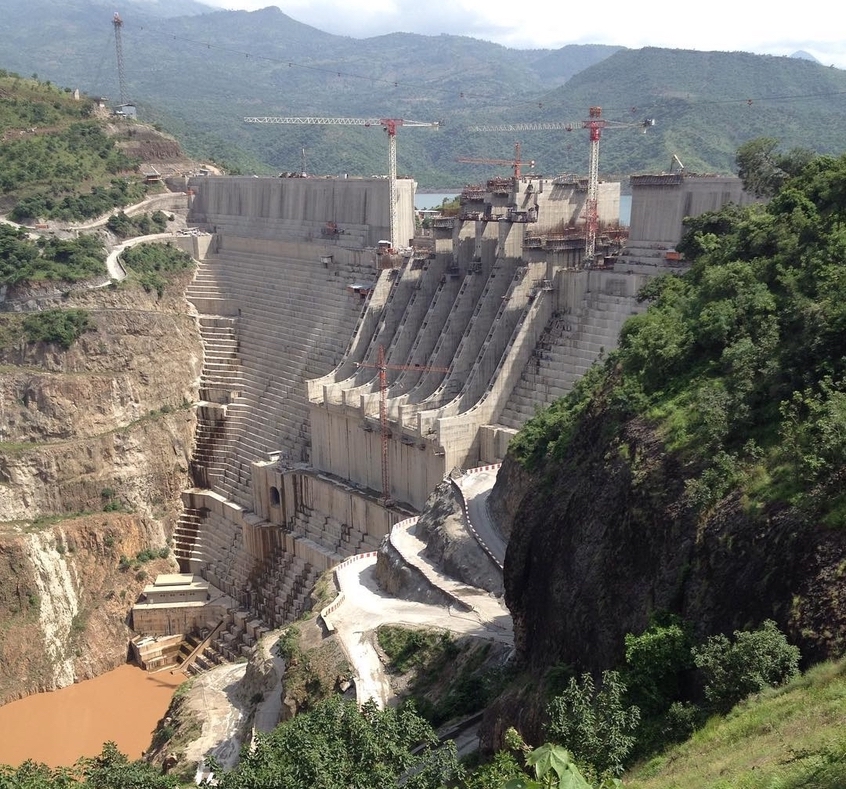
Dangerous Tekeze Dam of Ethiopia

—————

——————

spacer image Almost all the Earth’s new crust forms at divergent boundaries, but most are not well known because they lie deep beneath the oceans. These are zones where two plates move away from each other, allowing magma from the mantle to rise up and solidify as new crust. Click here to learn more about divergent plate boundaries.

spacer image This image shows a slice through the Earth at a convergent plate boundary. This view illustrates just one of the ways that plates behave when they collide. In this case, one plate is pulled beneath another (subduction), forming a deep trench. The long, narrow zone where the two plates meet is called a subduction zone.

The fate of the colliding plates depends mostly on what type of lithosphere they are made of. Plates with thick, buoyant continental lithosphere behave very differently from plates with thin, dense oceanic lithosphere! Click here to learn more about convergent plate boundaries.

The Earth is made up of a dozen or so major plates and several minor plates. Tectonic plates are constantly on the move. The fastest plate races along at 15 centimeters (6 inches) per year while the slowest plates crawl at less than 2.5 centimeters (1 inch) per year.

Map showing locations of the Earth’s plates

You’ll notice that most plates are part continental and part oceanic. Take the North American plate, for example. Its western half is dominated by the North American continent, but its eastern half forms part of the Atlantic Ocean basin. In comparison, the Pacific plate is essentially all oceanic.

———————

A satellite thermal-infrared photograph of a volcano in the Afar Triangle in the Horn of Africa

———————–

East African Rift

This satellite photograph shows how the movement of three tectonic plates is cracking open the Afar Triangle

NASA’s Position

NASA-

Our planet’s magnetic field is in a constant state of change, say researchers who are beginning to understand how it behaves and why.

Every few years, scientist Larry Newitt of the Geological Survey of Canada goes hunting. He grabs his gloves, parka, a fancy compass, hops on a plane and flies out over the Canadian arctic. Not much stirs among the scattered islands and sea ice, but Newitt’s prey is there–always moving, shifting, elusive.

The movement of Earth's north magnetic pole across the Canadian arctic, 1831-2001. Credit: Geological Survey of Canada.

————————-

At the moment it’s located in northern Canada, about 600 km from the nearest town: Resolute Bay, population 300, where a popular T-shirt reads “Resolute Bay isn’t the end of the world, but you can see it from here.” Newitt stops there for snacks and supplies–and refuge when the weather gets bad. “Which is often,” he says.

Right: The movement of Earth’s north magnetic pole across the Canadian arctic, 1831–2001. Credit: Geological Survey of Canada. [More]

Scientists have long known that the magnetic pole moves. James Ross located the pole for the first time in 1831 after an exhausting arctic journey during which his ship got stuck in the ice for four years. No one returned until the next century. In 1904, Roald Amundsen found the pole again and discovered that it had moved–at least 50 km since the days of Ross.

The pole kept going during the 20th century, north at an average speed of 10 km per year, lately accelerating “to 40 km per year,” says Newitt. At this rate it will exit North America and reach Siberia in a few decades.

Keeping track of the north magnetic pole is Newitt’s job. “We usually go out and check its location once every few years,” he says. “We’ll have to make more trips now that it is moving so quickly.”

Earth’s magnetic field is changing in other ways, too: Compass needles in Africa, for instance, are drifting about 1 degree per decade. And globally the magnetic field has weakened 10% since the 19th century. When this was mentioned by researchers at a recent meeting of the American Geophysical Union, many newspapers carried the story. A typical headline: “Is Earth’s magnetic field collapsing?”

Probably not. As remarkable as these changes sound, “they’re mild compared to what Earth’s magnetic field has done in the past,” says University of California professor Gary Glatzmaier.

Magnetic stripes around mid-ocean ridges reveal the history of Earth's magnetic field for millions of years. The study of Earth's past magnetism is called paleomagnetism. Image credit: USGS.

Sometimes the field completely flips. The north and the south poles swap places. Such reversals, recorded in the magnetism of ancient rocks, are unpredictable. They come at irregular intervals averaging about 300,000 years; the last one was 780,000 years ago. Are we overdue for another? No one knows.

Above: Magnetic stripes around mid-ocean ridges reveal the history of Earth’s magnetic field for millions of years. The study of Earth’s past magnetism is called paleomagnetism. Image credit: USGS. [More]

According to Glatzmaier, the ongoing 10% decline doesn’t mean that a reversal is imminent. “The field is increasing or decreasing all the time,” he says. “We know this from studies of the paleomagnetic record.” Earth’s present-day magnetic field is, in fact, much stronger than normal. The dipole moment, a measure of the intensity of the magnetic field, is now 8 x 10²² amps x m2. That’s twice the million-year average of 4 x 10²² amps x m2.

To understand what’s happening, says Glatzmaier, we have to take a trip … to the center of the Earth where the magnetic field is produced.

At the heart of our planet lies a solid iron ball, about as hot as the surface of the sun. Researchers call it “the inner core.” It’s really a world within a world. The inner core is 70% as wide as the moon. It spins at its own rate, as much as 0.2o of longitude per year faster than the Earth above it, and it has its own ocean: a very deep layer of liquid iron known as “the outer core.”

A schematic diagram of Earth's interior. The outer core is the source of the geomagnetic field.

Right: a schematic diagram of Earth’s interior. The outer core is the source of the geomagnetic field. [Larger image]

Earth’s magnetic field comes from this ocean of iron, which is an electrically conducting fluid in constant motion. Sitting atop the hot inner core, the liquid outer core seethes and roils like water in a pan on a hot stove. The outer core also has “hurricanes”–whirlpools powered by the Coriolis forces of Earth’s rotation. These complex motions generate our planet’s magnetism through a process called the dynamo effect.

Using the equations of magnetohydrodynamics, a branch of physics dealing with conducting fluids and magnetic fields, Glatzmaier and colleague Paul Roberts have created a supercomputer model of Earth’s interior. Their software heats the inner core, stirs the metallic ocean above it, then calculates the resulting magnetic field. They run their code for hundreds of thousands of simulated years and watch what happens.

What they see mimics the real Earth: The magnetic field waxes and wanes, poles drift and, occasionally, flip. Change is normal, they’ve learned. And no wonder. The source of the field, the outer core, is itself seething, swirling, turbulent. “It’s chaotic down there,” notes Glatzmaier. The changes we detect on our planet’s surface are a sign of that inner chaos.

They’ve also learned what happens during a magnetic flip. Reversals take a few thousand years to complete, and during that time–contrary to popular belief–the magnetic field does not vanish. “It just gets more complicated,” says Glatzmaier. Magnetic lines of force near Earth’s surface become twisted and tangled, and magnetic poles pop up in unaccustomed places. A south magnetic pole might emerge over Africa, for instance, or a north pole over Tahiti. Weird. But it’s still a planetary magnetic field, and it still protects us from space radiation and solar storms.

Supercomputer models of Earth's magnetic field. On the left is a normal dipolar magnetic field, typical of the long years between polarity reversals. On the right is the sort of complicated magnetic field Earth has during the upheaval of a reversal.

Above: Supercomputer models of Earth’s magnetic field. On the left is a normal dipolar magnetic field, typical of the long years between polarity reversals. On the right is the sort of complicated magnetic field Earth has during the upheaval of a reversal. [More]

And, as a bonus, Tahiti could be a great place to see the Northern Lights. In such a time, Larry Newitt’s job would be different. Instead of shivering in Resolute Bay, he could enjoy the warm South Pacific, hopping from island to island, hunting for magnetic poles while auroras danced overhead.

Sometimes, maybe, a little change can be a good thing.

————————–

Go to Science@NASA home page

The Sun Does a Flip

NASA scientists who monitor the Sun say that our star’s awesome magnetic field is flipping — a sure sign that solar maximum is here.

NASA
Marshall Space Flight Center
Listen to this story (requires RealPlayer)

see captionFebruary 15, 2001 — You can’t tell by looking, but scientists say the Sun has just undergone an important change. Our star’s magnetic field has flipped.

The Sun’s magnetic north pole, which was in the northern hemisphere just a few months ago, now points south. It’s a topsy-turvy situation, but not an unexpected one.

”This always happens around the time of solar maximum,” says David Hathaway, a solar physicist at the Marshall Space Flight Center. “The magnetic poles exchange places at the peak of the sunspot cycle. In fact, it’s a good indication that Solar Max is really here.”

subscription image
Sign up for EXPRESS SCIENCE NEWS delivery

Above: Sunspot counts, plotted here against an x-ray image of the Sun, are nearing their maximum for the current solar cycle. [more information]The Sun’s magnetic poles will remain as they are now, with the north magnetic pole pointing through the Sun’s southern hemisphere, until the year 2012 when they will reverse again. This transition happens, as far as we know, at the peak of every 11-year sunspot cycle — like clockwork.

Earth’s magnetic field also flips, but with less regularity. Consecutive reversals are spaced 5 thousand years to 50 million years apart. The last reversal happened 740,000 years ago. Some researchers think our planet is overdue for another one, but nobody knows exactly when the next reversal might occur.

Although solar and terrestrial magnetic fields behave differently, they do have something in common: their shape. During solar minimum the Sun’s field, like Earth’s, resembles that of an iron bar magnet, with great closed loops near the equator and open field lines near the poles. Scientists call such a field a “dipole.” The Sun’s dipolar field is about as strong as a refrigerator magnet, or 50 gauss (a unit of magnetic intensity). Earth’s magnetic field is 100 times weaker.

Below: The Sun’s basic magnetic field, like Earth’s, resembles that of a bar magnet.

see captionWhen solar maximum arrives and sunspots pepper the face of the Sun, our star’s magnetic field begins to change. Sunspots are places where intense magnetic loops — hundreds of times stronger than the ambient dipole field — poke through the photosphere.

Meridional flows on the Sun’s surface carry magnetic fields from mid-latitude sunspots to the Sun’s poles,” explains Hathaway. “The poles end up flipping because these flows transport south-pointing magnetic flux to the north magnetic pole, and north-pointing flux to the south magnetic pole.” The dipole field steadily weakens as oppositely-directed flux accumulates at the Sun’s poles until, at the height of solar maximum, the magnetic poles change polarity and begin to grow in a new direction.

Hathaway noticed the latest polar reversal in a “magnetic butterfly diagram.” Using data collected by astronomers at the U.S. National Solar Observatory on Kitt Peak, he plotted the Sun’s average magnetic field, day by day, as a function of solar latitude and time from 1975 through the present. The result is a sort of strip chart recording that reveals evolving magnetic patterns on the Sun’s surface. “We call it a butterfly diagram,” he says, “because sunspots make a pattern in this plot that looks like the wings of a butterfly.”

In the butterfly diagram, pictured below, the Sun’s polar fields appear as strips of uniform color near 90 degrees latitude. When the colors change (in this case from blue to yellow or vice versa) it means the polar fields have switched signs.

see captionAbove: In this “magnetic butterfly diagram,” yellow regions are occupied by south-pointing magnetic fields; blue denotes north. At mid-latitudes the diagram is dominated by intense magnetic fields above sunspots. During the sunspot cycle, sunspots drift, on average, toward the equator — hence the butterfly wings. The uniform blue and yellow regions near the poles reveal the orientation of the Sun’s underlying dipole magnetic field. [more information]

The ongoing changes are not confined to the space immediately around our star, Hathaway added. The Sun’s magnetic field envelops the entire solar system in a bubble that scientists call the “heliosphere.” The heliosphere extends 50 to 100 astronomical units (AU) beyond the orbit of Pluto. Inside it is the solar system — outside is interstellar space.

”Changes in the Sun’s magnetic field are carried outward through the heliosphere by the solar wind,” explains Steve Suess, another solar physicist at the Marshall Space Flight Center. “It takes about a year for disturbances to propagate all the way from the Sun to the outer bounds of the heliosphere.”

see captionBecause the Sun rotates (once every 27 days) solar magnetic fields corkscrew outwards in the shape of an Archimedian spiral. Far above the poles the magnetic fields twist around like a child’s Slinky toy.

Left: Steve Suess (NASA/MSFC) prepared this figure, which shows the Sun’s spiraling magnetic fields from a vantage point ~100 AU from the Sun.

Because of all the twists and turns, “the impact of the field reversal on the heliosphere is complicated,” says Hathaway. Sunspots are sources of intense magnetic knots that spiral outwards even as the dipole field vanishes. The heliosphere doesn’t simply wink out of existence when the poles flip — there are plenty of complex magnetic structures to fill the void.

Or so the theory goes…. Researchers have never seen the magnetic flip happen from the best possible point of view — that is, from the top down.

But now, the unique Ulysses spacecraft may give scientists a reality check. Ulysses, an international joint venture of the European Space Agency and NASA, was launched in 1990 to observe the solar system from very high solar latitudes. Every six years the spacecraft flies 2.2 AU over the Sun’s poles. No other probe travels so far above the orbital plane of the planets.

see caption“Ulysses just passed under the Sun’s south pole,” says Suess, a mission co-Investigator. “Now it will loop back and fly over the north pole in the fall.”

Right: Following an encounter with Jupiter in 1992, the Ulysses spacecraft went into a high polar orbit. It’s maximum solar latitude is 80.2 degrees south. [more]

”This is the most important part of our mission,” he says. Ulysses last flew over the Sun’s poles in 1994 and 1996, during solar minimum, and the craft made severalimportant discoveries about cosmic rays, the solar wind, and more. “Now we get to see the Sun’s poles during the other extreme: Solar Max. Our data will cover a complete solar cycle.”

To learn more about the Sun’s changing magnetic field and how it is generated, please visit “The Solar Dynamo,” a web page prepared by the NASA/Marshall solar research group. Updates from the Ulysses spacecraft may be found on the Internet from JPL at http://ulysses.jpl.nasa.gov.

————————

Magnetic Reversals

After molten lava emerges from a volcano, it solidifies to a rock. In most cases it is a black rock known as basalt, which is faintly magnetic, like iron emerging from a melt–for which Gilbert already noticed a similar process. Its magnetization is in the direction of the local magnetic force at the time when it cools down.Instruments can measure the magnetization of basalt. Therefore, if a volcano has produced many lava flows over a past period, scientists can analyze the magnetizations of the various flows and from them get an idea on how the direction of the local Earth’s field varied in the past. Surprisingly, this procedure suggested that times existed when the magnetization had the opposite direction from today’s. All sorts of explanation were proposed, but in the end the only one which passed all tests was that in the distant past, indeed, the magnetic polarity of the Earth was sometimes reversed.

four of those questions, with their answers.

Ocean Floor Magnetism

Mid-Atlantic Ridge

In the 1950s electronic magnetometers were developed. Unlike the older instruments, based on the compass needle, these could be towed behind an airplane or a ship. Oil companies were soon using them aboard airplanes, mapping the weak magnetism of rocks to help locate oil deposits. On land, the patterns of this magnetism seemed jumbled, with no meaningful order.Extending those measurements to the oceans, around 1960, revealed a surprising difference. In the ocean floor the magnetization was orderly, arranged in long strips. The strips on the Atlantic ocean floor, in particular, all seemed parallel to the “mid-Atlantic ridge.” That is a volcanic ridge running roughly north-to-south (with some zigs and zags), halfway between Europe-Africa and America. It is marked by the focus-points of earthquakes and by some volcanic islands, and more recently it was explored by research submarines, which have at times observed lava oozing out at its crest.

Ocean floor magnetization     (USGS figure)

Not only were the magnetic strips lined-up with the central ridge, but their structure and distribution seemed remarkably symmetric on both sides: if (say) a narrow-wide pair of strips was observed at a certain distance east of the ridge, its mirror image was also found at about the same distance to the west

———————–


—————-

Sub-ionospheric radio transmission.he infrastructure and activities of our modern technologically-based society can be adversely affected by rapid magnetic-field variations generated by electric currents in the near-Earth space environment, particularly in the ionosphere and magnetosphere. This is especially true during so-called ‘magnetic storms’. Because the ionosphere is heated and distorted during storms, long-range radio communication, which relies on sub-ionospheric reflection, can be difficult or impossible and global-positioning systems (GPS), which relies on radio transmission through the ionosphere, can be degraded. Ionospheric expansion can enhance satellite drag and thereby make their orbits difficult to control. During magnetic storms, satellite electronics can be damaged through the Earth surrounded by GPS satellites.build up and subsequent discharge of static-electric charges, and astronaut and high-altitude pilots can be subjected to increased levels of radiation. There can even be deleterious effects on the ground: pipe-line corrosion can be enhanced, and electric-power grids can experience voltage surges that cause blackouts. The reason why space-based effects can have consequences down here on the Earth’s surface is related, at least in part, to our answer to the first question, ‘What is a magnetic field?’. Electric power-line towers.Electric currents in one place can induce electric currents in another place, this action at a distance is accomplished via a magnetic field. So, even though rapid magnetic-field variations are generated by currents in space, very real effects, such as unwanted electric currents induced in electric-power grids, can result down here on the Earth’s surface. More generally, the hazardous effects associated with geomagnetic activity, which are discussed more fully in the Further Reading page of this website, are one reason why the USGS Geomagnetism Program is part of the Central Region

Aurorae are a luminous glow of the upper atmosphere caused by energetic particles descending from the Earth’s magnetosphere or coming directly from the Sun. These energetic particles are mostly electrons, but protons can also be involved, and their energetic rain into the atmosphere is greatest during magnetic storms. As the particles descend, they collide with molecules in the atmosphere, causing an excitation of the oxygen and nitrogen molecular electrons. The molecules can return to their original, unexcited state by emitting a bit of light, a photon. This light, a photograph of which appears in the banner of this website, is the aurora that we see. Since electrically-charged particles tend to follow magnetic-field lines, and since magnetic-field lines are oriented in and out of the Earth and its atmosphere, near the magnetic poles, aurorae tend to be seen at high latitudes.Aurora in the night sky.

Categories

Ethiopian Power Taking

Prof. Books

Recent Comments